One of the greatest challenges as a scientist is being able to effectively communicate your work to others. The other challenge is being able to read and comprehend those published works. Here I will explain the difference between review and primary articles and how to best tackle them!
Review Articles (Secondary Literature).
These articles are great for getting a comprehensive overview and summary of the work that has been done on topic you are reading about to date. Review articles are full of information and primary article sources, but you wont find much figures of individual experiments. Review articles typically have graphical pathways and big picture figures that summarize work that has been done. These articles read more like a narrative and tend to spare you of methods and materials details. If you are looking to take your first dive into a topic, find the most recent review article. Review articles are where you can become introduced and acclimated to a topic before looking for specific information. Review articles are simply that, a review. These articles will show you the whole picture.
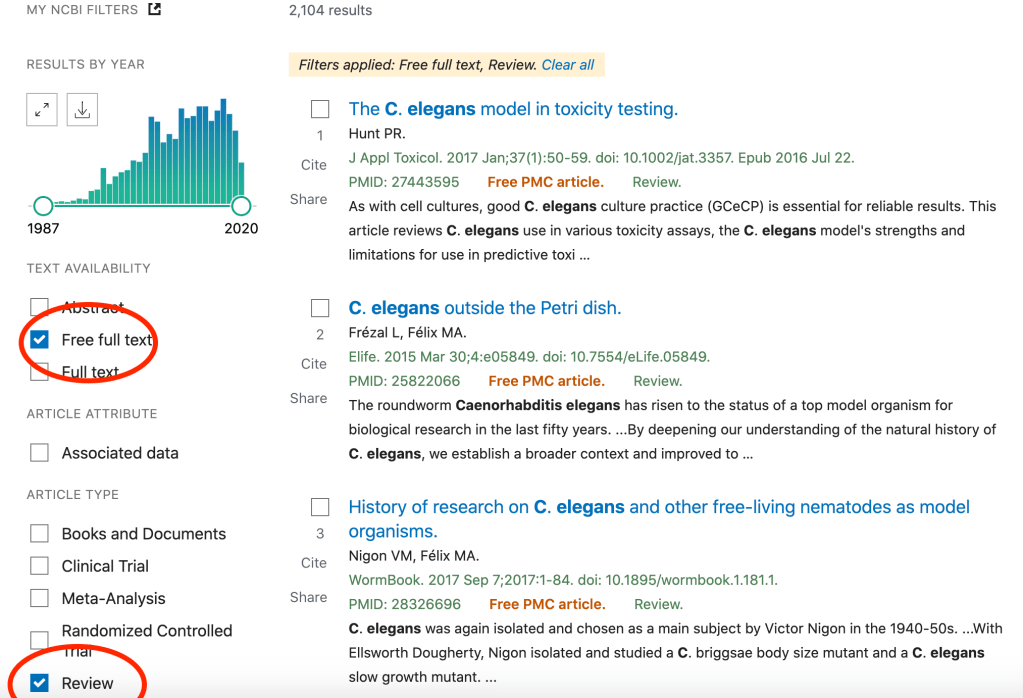
Example: PubMed search for “c. elegans”: with filters of “free full text” so you can read it for free, and “review” so you can find review articles! Notice the titles of these papers and how broad they are.
Research Articles (Primary Literature).
Use primary articles to find more specific details about a topic. Primary articles are going to have the standard format with an abstract, introduction, materials and methods, results, and discussion, but will be written very specifically for that set of experiments. Primary articles will have many figures and supplementary figures to support the work done in that paper with specific details about the experiments done and the materials and methods used. This original research will contribute to the larger scale topic that the paper focuses on. Primary articles are just one scene of the whole picture.
Example: PubMed search for “c. elegans sleep”: with filters of “free full text” so you can read it for free, and nothing else. Notice how I was more specific in my search of c. elegans, this will provide primary articles, the most recent/ relevant research articles related to your search.

Where do you start reading?
It may seem obvious, to start from the beginning, but it is not always necessary. There are many approaches in tackling an article, and it does not always mean you have to read it fully from start to finish. There is no shortcut to understanding a paper, but the way you may read it depends on your reading purpose .
- First, I always read the title and the abstract. It’s the shortest way to understand the paper without reading the entire thing, and it is there for a reason! So read it multiple times to get a better understanding and see if this paper fits the purpose you are reading it for.
- Second, I look at the figures, results and discussion. I want to know what the findings were of the paper, how they got them, and at the end of the day and how this applies to the next steps for this topic.
- Third, I fill in the gaps of my understanding by finding what is not clear to me in the introduction or methods. If I don’t understand why they did a certain experiment I look at the intro for context. If I don’t understand how they did an experiment I look at the methods for an explanation.
Reading published literature does not have to be scary or boring! Some papers are written really well and you find yourself understanding the first time around, others this may not be the case. Do not let this discourage you, practice makes perfect! The more you read the easier it gets.

 Madison (Honer) Lineberger